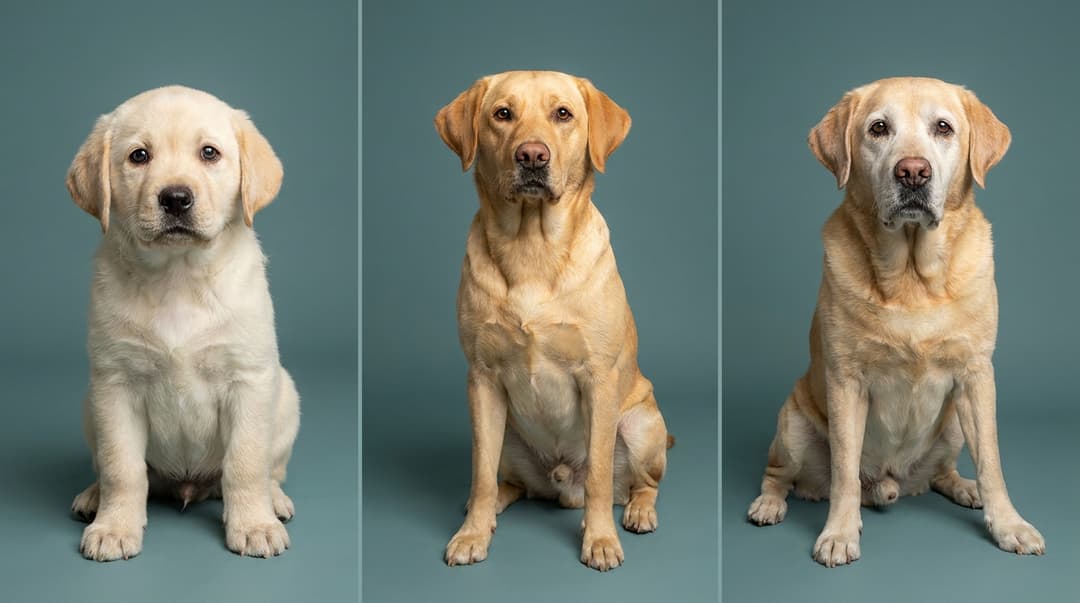
How to Use the Lifespan Calculator
Step 1 — Select pet type: Dog or Cat. Dogs and cats have fundamentally different lifespan distributions. Cat lifespans are more uniform across breeds — most domestic cats live 12–18 years with indoor lifestyle being the dominant variable. Dog lifespans vary dramatically by size and breed — from 7 years for some giant breeds to 18 years for some toy breeds. Selecting the correct species loads the appropriate lifespan model.
Step 2 — Select your pet's breed. Breed is the most important lifespan factor after size. Within the same size category, different breeds have meaningfully different average lifespans driven by genetic health baggage, historical breeding practices, and known hereditary conditions. A Labrador Retriever and a Golden Retriever are both large breeds but Goldens have significantly higher cancer rates — approximately 60% lifetime risk — that affect average lifespan. The calculator applies breed-specific longevity data derived from veterinary population studies.
Step 3 — Enter current age. Current age allows the calculator to show remaining expected lifespan in addition to total expected lifespan. A 5-year-old Beagle with a 13-year average lifespan has approximately 8 years of expected remaining life — useful context for financial planning, insurance decisions, and senior care preparation timelines.
Step 4 — Select size category. Size is the strongest single predictor of lifespan in dogs — stronger even than breed for mixed-breed dogs. If your dog is a mixed breed and you have not selected a specific breed, size category alone generates a reasonable lifespan estimate. Toy and small breeds average 13–17 years. Medium breeds 11–14 years. Large breeds 9–12 years. Giant breeds 7–10 years.
Step 5 — Select health status, lifestyle, spay/neuter status, and environment. These factors adjust the baseline estimate. Spayed and neutered pets have statistically longer lifespans — studies show neutered male dogs live 13.8% longer on average than intact males, and spayed females live 26.3% longer than intact females. Indoor cats live dramatically longer than outdoor cats. Good health status with regular vet care extends lifespan at the population level. These are not guarantees for your individual pet — they are statistical adjustments to the breed baseline.
Understanding Your Results
Why lifespan estimates are ranges, not fixed numbers. Lifespan is a population statistic — the average age at death for a group of animals of a given breed and size. Individual variation within any breed is enormous. A Golden Retriever may live 8 years or 15 years — both are within the documented range. The estimate tells you the central tendency and the realistic range for your breed, which is useful for planning but should never be treated as a prediction for your specific pet.
The size-lifespan relationship in dogs — why it exists. The inverse relationship between body size and lifespan in dogs is one of the most well-documented but poorly understood phenomena in biology. Larger dogs age faster at a cellular level — their bodies grow more rapidly during development, and this accelerated cellular activity appears to continue throughout life, correlating with faster aging and higher cancer rates. A Great Dane grows from 0.5kg at birth to 70kg in 18 months — a rate of growth that compresses developmental processes that take humans 18 years into 18 months. This compressed timeline appears to accelerate the entire biological clock.
How spaying and neutering affects lifespan. Research from the University of Georgia analysed death records of over 70,000 dogs and found that neutered males lived 13.8% longer than intact males and spayed females lived 26.3% longer than intact females. The primary reasons are: elimination of reproductive cancers (mammary tumours, testicular cancer, pyometra in females), reduced roaming and fighting behaviour, and hormonal changes that reduce aggression-related injury risk. The relationship is not entirely simple — some research suggests neutering at certain ages in certain breeds increases joint disease risk — but the overall lifespan effect of neutering is positive across the population.
Factors you can control that meaningfully affect lifespan. While breed and size are fixed, several owner-controlled factors have statistically significant effects on lifespan. Maintaining healthy weight is the most impactful controllable factor — a landmark Purina study showed that Labrador Retrievers kept lean throughout life lived a median of 1.8 years longer than their overweight littermates. Annual dental cleanings reduce the bacterial load that contributes to heart and kidney disease in later life. Regular preventive vet care catches conditions like hypothyroidism, heart disease, and cancer early when they are most treatable. Indoor lifestyle for cats nearly doubles average lifespan compared to outdoor or free-roaming cats.
What the remaining lifespan estimate means practically. The remaining lifespan figure is useful for several planning decisions: pet insurance (knowing your pet is entering a high-cost health period in 3–4 years informs whether to insure now), senior diet transition timing (most breeds benefit from senior nutritional adjustments at approximately 75% of expected lifespan), and financial planning for end-of-life care. It is not a countdown — many pets outlive their breed average significantly with good care.
Lifespan Reference Tables
Dog Lifespan by Breed — Common Breeds
| Breed | Size | Average Lifespan | Range | Primary Health Risks |
|---|---|---|---|---|
| Chihuahua | Toy | 14–17 years | 12–20 | Dental, patellar luxation, heart |
| Yorkshire Terrier | Toy | 13–16 years | 11–18 | Dental, tracheal collapse, portosystemic shunt |
| Toy Poodle | Toy | 14–18 years | 12–20 | Dental, patellar luxation |
| Maltese | Toy | 12–15 years | 10–18 | Dental, liver shunts |
| Shih Tzu | Toy | 10–16 years | 9–18 | Eye, dental, brachycephalic |
| Pug | Toy | 12–15 years | 10–16 | Respiratory, eye, obesity |
| French Bulldog | Small | 10–12 years | 8–14 | Respiratory (BOAS), spinal, heat |
| Beagle | Medium | 12–15 years | 10–17 | Obesity, epilepsy, eye |
| Border Collie | Medium | 12–15 years | 10–17 | Collie eye anomaly, hip dysplasia |
| Australian Shepherd | Medium | 13–15 years | 12–18 | Hip dysplasia, eye conditions |
| Cocker Spaniel | Medium | 12–14 years | 10–16 | Ear, eye, heart |
| Labrador Retriever | Large | 10–12 years | 8–14 | Obesity, hip/elbow dysplasia, cancer |
| Golden Retriever | Large | 10–12 years | 8–13 | Cancer (~60% lifetime risk), hip dysplasia |
| German Shepherd | Large | 9–13 years | 7–15 | Hip dysplasia, degenerative myelopathy |
| Boxer | Large | 9–11 years | 8–12 | Cancer, heart disease (DCM, AS) |
| Doberman Pinscher | Large | 10–13 years | 9–14 | Dilated cardiomyopathy, Von Willebrand |
| Rottweiler | Large | 8–11 years | 7–12 | Joint disease, cancer, heart |
| Great Dane | Giant | 7–10 years | 6–11 | Bloat (GDV), heart disease, joint |
| Saint Bernard | Giant | 8–10 years | 6–11 | Joint, heart, bloat |
| Bernese Mountain Dog | Giant | 6–9 years | 5–10 | Cancer (highest rate of any breed), joint |
| Irish Wolfhound | Giant | 6–8 years | 5–9 | Heart disease, bone cancer |
| Newfoundland | Giant | 8–10 years | 7–11 | Heart, joint, bloat |
Cat Lifespan by Breed
| Breed | Average Lifespan | Range | Primary Health Risks | Notes |
|---|---|---|---|---|
| Domestic Shorthair (indoor) | 15–17 years | 12–22 | Dental, kidney disease, obesity | Most common; wide variation |
| Domestic Shorthair (outdoor) | 5–7 years | 2–12 | Trauma, infectious disease, predation | Dramatically lower than indoor |
| Siamese | 15–20 years | 12–25 | Dental, respiratory, amyloidosis | One of the longest-lived breeds |
| Maine Coon | 13–18 years | 10–20 | Hypertrophic cardiomyopathy, hip dysplasia | Large breed — cardiac screening recommended |
| Ragdoll | 15–18 years | 12–20 | Hypertrophic cardiomyopathy | Screen for heart disease |
| Persian | 13–15 years | 10–18 | Polycystic kidney disease, brachycephalic, dental | PKD testing of parents critical |
| Bengal | 14–16 years | 12–18 | Hypertrophic cardiomyopathy, PRA | Active breed; needs enrichment |
| British Shorthair | 14–20 years | 12–22 | Hypertrophic cardiomyopathy | Stocky build; obesity risk |
| Abyssinian | 12–15 years | 10–17 | Renal amyloidosis, PRA, dental | Very active |
| Scottish Fold | 11–14 years | 9–16 | Osteochondrodysplasia (joint disease) | Controversial breed due to health concerns |
| Sphynx | 13–15 years | 10–18 | Hypertrophic cardiomyopathy, skin | Regular bathing required |
| Russian Blue | 15–20 years | 13–22 | Generally healthy; dental | One of the healthiest cat breeds |
| Burmese | 16–18 years | 14–22 | Dental, diabetes | Long-lived; can reach early 20s |
Lifespan by Dog Size — Summary
| Size Category | Weight Range | Average Lifespan | Senior Age | Geriatric Age |
|---|---|---|---|---|
| Toy | Under 4.5 kg | 14–17 years | 10 years | 14 years |
| Small | 4.5–10 kg | 13–16 years | 9 years | 13 years |
| Medium | 10–25 kg | 11–14 years | 8 years | 12 years |
| Large | 25–45 kg | 9–12 years | 7 years | 10 years |
| Giant | Over 45 kg | 7–10 years | 5–6 years | 8 years |
Factors That Extend Lifespan — Evidence-Based
| Factor | Effect | Evidence |
|---|---|---|
| Maintaining healthy weight | +1.8 years in dogs (Purina study, Labrador cohort) | Strong — landmark 14-year controlled study |
| Spaying (female dogs) | +26.3% lifespan vs intact | Strong — University of Georgia, 70,000 dog dataset |
| Neutering (male dogs) | +13.8% lifespan vs intact | Strong — same dataset |
| Indoor lifestyle (cats) | 2–3× longer lifespan vs outdoor | Strong — population-level data consistently shows this |
| Annual dental cleaning | Reduces cardiac and kidney disease risk | Moderate — bacterial load from dental disease linked to organ disease |
| Regular preventive vet care | Earlier detection of treatable conditions | Moderate — disease caught at earlier stage responds better to treatment |
| High-quality nutrition | Associated with longer health span | Moderate — difficult to isolate from other socioeconomic factors |
| Low-stress environment | Reduced cortisol associated with better immune function | Emerging — human studies stronger than pet studies |
Questions about this calculator
US average is 11–12 years overall. Small breeds 13–17 years; giant breeds 7–10 years. Breed matters as much as size — use the calculator for a breed-accurate estimate.